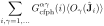
Elastic Energy $E_{\rm elastic}$

The elastic energy $E_{\rm elastic}$ is bilinear in $a$


$\displaystyle E_{\rm elastic}$ $\textstyle =$ $\displaystyle \frac{1}{2}\sum_{ij} \frac{c_L(ij)-c_T(ij)}{2\vert\mathbf R_{ij}\vert^2}
(\mathbf R_{ij}^T\bar a \mathbf R_{ij})^2$(103)
    $\displaystyle + \frac{c_T(ij)}{2} \mathbf R_{ij}^T\bar a^T\bar a \mathbf R_{ij}$ 
  $\textstyle =$ $\displaystyle \frac{1}{2} \sum_{ij,\alpha\beta\gamma\delta} \frac{c_L(ij)-c_T(i...
...ha}R_{ij}^{\beta}R_{ij}^{\gamma}R_{ij}^{\delta}
a_{\alpha\beta}a_{\gamma\delta}$ 
    $\displaystyle + \frac{c_T(ij)}{2} R_{ij}^{\alpha} R_{ij}^{\delta}
a_{\alpha\beta} \delta_{\beta\gamma} a_{\gamma\delta}$ 

We calculate it's derivative with respect to $a_{\alpha\beta}$:


$\displaystyle \frac{\partial E_{\rm elastic}}{\partial a_{\alpha\beta}}$ $\textstyle =$ $\displaystyle \frac{1}{2}\sum_{ij,\gamma\delta} \frac{c_L(ij)-c_T(ij)}{\vert\ma...
...2}
R_{ij}^{\alpha}R_{ij}^{\beta}R_{ij}^{\gamma}R_{ij}^{\delta}
a_{\gamma\delta}$ 
    $\displaystyle + \frac{c_T(ij)}{2} R_{ij}^{\alpha}R_{ij}^{\delta}
\delta_{\beta\gamma} a_{\gamma\delta} +$ 
    $\displaystyle \frac{c_T(ij)}{2} R_{ij}^{\gamma} R_{ij}^{\beta}
a_{\gamma\delta} \delta_{\delta\alpha}$(104)

An we make also use of the definition of elastic constants (important note: these are not the effective elastic constants, which can be determined experimentally, because they do not take into account, that the atomic positions relax when the crystal is strained. To relax atomic positions and compute effective elastic constants use option -cel of program mcphasit):


$\displaystyle c^{\alpha\beta\gamma\delta}$ $\textstyle =$ $\displaystyle \frac{\partial^2E_{\rm elastic}}{\partial a_{\alpha\beta} \partial a_{\gamma\delta}}$(105)
  $\textstyle =$ $\displaystyle \frac{1}{2}\sum_{ij}\frac{c_L(ij)-c_T(ij)}{\vert\mathbf R_{ij}\vert^2}
R_{ij}^{\alpha}R_{ij}^{\beta}R_{ij}^{\gamma}R_{ij}^{\delta}$ 
    $\displaystyle + \frac{c_T(ij)}{2} R_{ij}^{\alpha}R_{ij}^{\delta}
\delta_{\beta\gamma} +$ 
    $\displaystyle \frac{c_T(ij)}{2} R_{ij}^{\gamma} R_{ij}^{\beta}
\delta_{\delta\alpha}$(106)

we make use of the fact that the strain $\bar \epsilon$ is a symmetric tensor ( $\epsilon_{\alpha\beta}=\epsilon_{\beta\alpha}$) and a rotation is antisymmetric ( $\omega_{\alpha\beta}=-\omega_{\beta\alpha}$) and the linear transformation $\bar a$ can be written as $\bar a=\bar \epsilon + \bar \omega$. Thus it is possible to rewrite the elastic energy in the well known fashion


$\displaystyle E_{\rm elastic}$ $\textstyle =$ $\displaystyle \frac{1}{2}\sum_{\alpha\beta\gamma\delta} c^{\alpha\beta\gamma\delta} \epsilon_{\alpha\beta}\epsilon_{\gamma\delta}$(107)

Note that we have neglected the fact, that nonzero transversal springs will result in a dependence of the elastic energy on the rotation tensor $\bar \omega$ as can been seen by inserting a rotation into the second part of (107). 22 Therefore transversal springs have to be used with caution in the description of a phonon spectrum.

Note that the transversal spring part in the elastic constants as defined in (109) is not symmetric upon exchange of indices. It is convenient to use a symmetrized version of the elastic constants, which will yield the same elastic energy, because the strain tensor is symmetric:


$\displaystyle c^{\alpha\beta\gamma\delta}$ $\textstyle =$ $\displaystyle \frac{1}{2}\sum_{ij}\frac{c_L(ij)-c_T(ij)}{\vert\mathbf R_{ij}\vert^2}
R_{ij}^{\alpha}R_{ij}^{\beta}R_{ij}^{\gamma}R_{ij}^{\delta}$ 
    $\displaystyle + \frac{c_T(ij)}{4} ( R_{ij}^{\alpha}R_{ij}^{\delta}
\delta_{\beta\gamma} +$ 
    $\displaystyle R_{ij}^{\gamma} R_{ij}^{\beta}
\delta_{\delta\alpha}$ 
    $\displaystyle + R_{ij}^{\beta}R_{ij}^{\delta}
\delta_{\alpha\gamma} + R_{ij}^{\gamma}R_{ij}^{\alpha}
\delta_{\delta\beta} )$ 

With the help of elastic constants we can rewrite the derivative of the elastic energy (111), again ignoring the rotation dependence:


$\displaystyle \frac{\partial E_{\rm elastic}}{\partial \epsilon_{\alpha\beta}}$ $\textstyle =$ $\displaystyle \sum_{\gamma\delta=1,2,3} c^{\alpha\beta\gamma\delta} \epsilon_{\gamma\delta}$(108)

To easy the indexing we apply the notation of Voigt

$\displaystyle \epsilon_1$ $\textstyle =$ $\displaystyle \epsilon_{11}$(109)
$\displaystyle \epsilon_2$ $\textstyle =$ $\displaystyle \epsilon_{22}$ 
$\displaystyle \epsilon_3$ $\textstyle =$ $\displaystyle \epsilon_{33}$ 
$\displaystyle \epsilon_4$ $\textstyle =$ $\displaystyle 2\epsilon_{23}=2\epsilon_{32}$ 
$\displaystyle \epsilon_5$ $\textstyle =$ $\displaystyle 2\epsilon_{31}=2\epsilon_{13}$ 
$\displaystyle \epsilon_6$ $\textstyle =$ $\displaystyle 2\epsilon_{12}=2\epsilon_{21}$ 

Note the elastic constants do not contain any prefactor in Voigt notation, i.e.

$\displaystyle c^{11}$ $\textstyle =$ $\displaystyle c^{1111}$(110)
$\displaystyle c^{44}$ $\textstyle =$ $\displaystyle c^{2323}$ 

There are 21 independent elastic constants, $c^{\alpha\beta}$ with $\beta=1,...,6$ and $\alpha \le \beta$ (or less, see http://koski.ucdavis.edu/BRILLOUIN/CRYSTALS/Elasticities.html). The other 60 elastic constants can be obtained from the symmetry relations $c^{\alpha\beta}=c^{\beta\alpha}$, $c^{\alpha\beta\gamma\delta}=c^{\beta\alpha\gamma\delta}=c^{\alpha\beta\delta\gamma}$.

The elastic energy in Voigt notation is given by
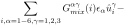

$\displaystyle E_{\rm elastic}$ $\textstyle =$ $\displaystyle \frac{1}{2}\sum_{\alpha\gamma=1,..,6} c^{\alpha\gamma} \epsilon_{\alpha}\epsilon_{\gamma}$(111)