


Next: Single-ion electrostatic and spin-orbit Up: Summary Previous: Exchange striction Contents Index
A three dimensional Einstein oscillator (for atom  ) in a solid can be
described by the following Hamiltonian
) in a solid can be
described by the following Hamiltonian
 (19)
(19)
Here
 is the dimensionless displacement vector
 ,
with the Bohr radius
,
with the Bohr radius  Angstrom),
  the mass of the atom
,
the mass of the atom
,
 the conjugate momentum to
 and
and
 the matrix describing the restoring force.
External force  can correspond to the electric field
 , i. e.
 ,
where Bohr radius
,
where Bohr radius  is included in order to yield
 in units of meV.
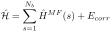
Coupling such oscillators leads to the Hamiltonian
 (20)
(20)
 and interaction parameters are
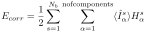 .
.