


Next: Crystal Field Phonon Interaction Up: Including Phonons, Electrical Polarisation Previous: Using Single Ion Module Contents Index
In equation (91) the force  may also come from an
electric field
may also come from an
electric field
 , i.e.
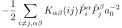 (96)
(96)
The Bohr radius  is included in order to yield in units of meV.
The resulting electric polarisation
 can be calculated by mcphas
and is stored in output file results/mcphas.fum. This electric polarisation refers to
the orientational polarisation generated by moving ions from their equilibrium positions. It does
not include the molecular electric dipole moment induced by the electric field.
can be calculated by mcphas
and is stored in output file results/mcphas.fum. This electric polarisation refers to
the orientational polarisation generated by moving ions from their equilibrium positions. It does
not include the molecular electric dipole moment induced by the electric field.
 (97)
(97)
Note that in addtion there may be a static polarisation
 (i.e. electret matter), which is calculated using
the Wigner Seitz unit cell of the primitive lattice and summing the dipolar moment contributions
of all charges, this static polarisation is output in the header of results/mcphas.fum.
(i.e. electret matter), which is calculated using
the Wigner Seitz unit cell of the primitive lattice and summing the dipolar moment contributions
of all charges, this static polarisation is output in the header of results/mcphas.fum.
 (98)
(98)